
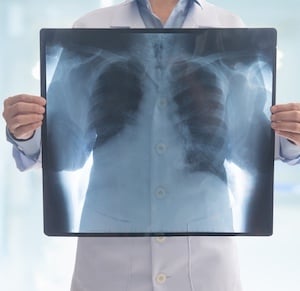
Photo: Getty Images
April 29, 2026 — Results from a new study* presented at the American Roentgen Ray Society’s (ARRS) 2026 annual meeting in Pittsburgh, PA, examined the potential for AI to identify lung cancers initially missed on routine chest X-ray at a large US quaternary medical center.
It highlights the growing clinical value of AI as a safety net for chest radiograph interpretation using the FDA cleared AI solution qXR-LN from Qure.ai. The AI solution can detect lung nodules on chest X-rays (CXR), which may warrant further clinical evaluation. Finding lung cancer before it spreads can change the entire trajectory of patient care, increasing five-year survival rates, improving quality of life lived, and can be the difference between curative and palliative treatments.
A retrospective study conducted at University Hospitals Cleveland Medical Center analyzed historical cases drawn from a resident education database maintained by its cardiothoracic radiology section. The dataset included chest X-rays performed more than three years earlier for unrelated clinical indications, in which no pulmonary nodule had been reported on the initial read.
These chest X-rays were later linked to patients who subsequently received a lung cancer diagnosis through other clinical pathways, with confirmation by CT imaging and biopsy. The study period covered cases identified between January 14, 2021, and March 6, 2025, with cough being the most common presenting symptom prompting later imaging investigation.
Key X-Ray Findings:
- qXR-LN delivered an AI-enhanced detection rate of 26.7%.
- AI identified nodules associated with 2 of 5 (40%) early-stage cancers, and 50% of missed Stage 1A nodules.
- Most missed nodules were in CXRs where indication was Trauma/Injury. AI identified 2 of 3 (66.7%) of these nodules, even when clinical focus was elsewhere.
- Detected nodules were associated with cancers across all clinical stages: Stage I (46.6%), Stage II (6.6%), Stage III (13.3%), Stage IV (33.3%).
- Median time from initial CXR to confirmed lung cancer diagnosis was 4.78 months, with some delays extending to 18 months.
- Detected nodules were distributed across lobes, primarily in the left upper lobe (40%) and right upper lobe (33%). Shows how AI can detect risk of nodules across anatomically challenging lobar regions as well.
“Pulmonary nodules missed on chest radiographs remain a challenge in thoracic imaging, especially when findings are subtle, obscured by overlaying anatomy or reviewed in busy emergency or outpatient settings. Delayed recognition can allow small lesions to progress to more advanced-stage lung cancer when curative treatment options diminish,” states Amit Gupta, MD, Division Chief of Cardiothoracic Imaging and Modality Director of Diagnostic Radiography at University Hospitals Cleveland Medical Center. “This study is helping produce real-world evidence and confidence for the imaging community about embracing AI as a support tool and as a second set of eyes.”
“The significance of this study is highlighting the power of integrating AI-assisted interpretation into routine chest radiograph workflows in the US, which will substantially reduce missed diagnoses and improve early-stage lung cancer detection. This has the potential to give radiologists and pulmonologists a new powerful tool to save lives,” states Samir Shah, MD, Chief Medical Officer at Qure.ai.
*"Evaluation of an FDA-Approved AI Algorithm for Missed Lung Cancer Detection on Chest Radiographs." Natally AlArab, Syed Muhammad Awais Bukhari, Sreyes Venkatesh, Kianoush AnsariGilani, Amit Gupta Presented at ARRS 2026 April 12-15, Pittsburgh, PA, US.

 June 05, 2026


